In plant and piping design, solutions are made far into the future
Plant and piping design plays a key role in the safety, reliability and efficiency of production plants. The design must coordinate the plant’s processes, technical systems, safety requirements, operator and maintenance needs – often with a view to decades of operation.
Different industries also set their own special requirements for engineering design. What are they like, and why is high-quality design also a competitive factor for an industrial company?
Plant and piping design is an integrated discipline
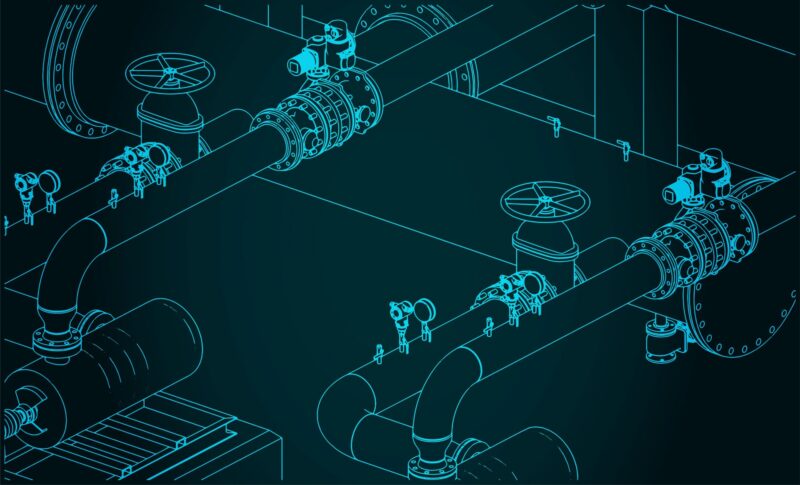
Plant design covers the design of industrial plants, production environments and related systems. Piping design, on the other hand, focuses on pipelines and their components that move liquids, gases and other substances. Pipe supports are an integral part of a piping system. Their design requires specialised expertise, as factors such as high process temperatures and equipment-induced vibrations introduce unique engineering challenges.
The design process defines equipment layouts and piping routes while taking operational and maintenance requirements into account and ensuring the effective integration of different technical systems. The goal is a functional, safe and sustainable entity that meets the technical and regulatory requirements set for it.
Work is currently mainly done in 3D environments. With the help of a digital model, the plant can be examined as a whole even before construction and conflicts between different systems can be identified at an early stage. This can reduce changes and repairs in the later stages of the project.
Different industries set different requirements for design
The fundamental principles of design are largely the same regardless of the industry, but the operating environment has a significant impact on the solutions. At Comatec, our experts work on plant and piping design projects across a broad range of industrial sectors.
“For example, in the process and chemical industries, particular emphasis is placed on material compatibility and the management of environmental impacts. Our experts must understand the specific characteristics of each process and address the associated risks throughout the plant’s entire lifecycle,” says Janne Lammela, CEO of Comatec Process and Automation Oy.
In power plants and other energy sector facilities, piping systems are required to operate reliably under high temperatures and pressures. This places particular emphasis on material selection, stress analysis, and structural integrity throughout the design process.
In the forest industry, plant modifications are often driven by the need to improve production efficiency or expand capacity within an existing facility. New equipment and systems must therefore be carefully integrated into the plant’s existing structures and processes while minimising disruption to ongoing operations.
Safety and lifecycle guide engineering decisions
Safety is a key consideration in plant and piping design. Alongside the safety of personnel and processes, engineers must also address environmental impacts when developing design solutions across the plant lifecycle.
At the same time, the focus is increasingly shifting towards the entire lifecycle of the plant. In addition to investment costs, factors such as maintainability, energy efficiency and long-term operational reliability are carefully evaluated. Effective design enables future capacity expansions, process modifications and the adoption of new technologies as operational requirements evolve.
Digital design methods support this work. The models can be used to examine, for example, pipeline routing, maintenance facilities and installability before implementation. In this way, potential problem areas can be detected already at the design stage instead of only encountering them on site.
Multidisciplinary expertise is key to successful design projects
Effective plant and piping design combines technical excellence with a deep understanding of the customer’s processes and operating environment. Projects are typically delivered by multidisciplinary teams, bringing together expertise in process, mechanical, electrical, automation, and structural engineering to develop safe, efficient, and fit-for-purpose solutions.
“In large-scale design entities, the technical, financial and scheduling goals of the project must be reconciled. When our experts are involved in the early stages of the project, both the objectives of the investment and the plant’s long-term performance can be taken into account in the solutions,” Lammela sums up.
Industry expertise, strong technical competence and close collaboration with the customer help identify solutions that support production not only during commissioning but throughout the entire lifecycle of the plant.