In the footsteps of Aulis Asikainen
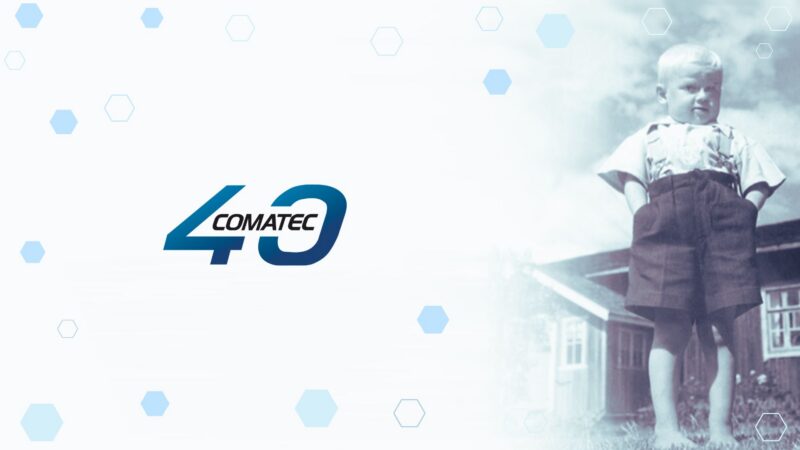
This is the story of Aulis Asikainen, Comatec Group’s CEO and major shareholder, who founded Comatec in 1986.
Aulis Asikainen’s life story traces a path from the eldest child of a smallholder family in the village of Pölläkkä in Heinävesi, Finland to the long‑standing head of an international technology group.
This article tells the story of an engineer with a passion for technology, who learned the value of hard work early on, reached the brink of exhaustion in salaried employment, and decided to establish his own company. Over four decades, a single office grew into a group of nearly six hundred specialists, built around specialised expertise, quality, and long‑term customer cooperation.
The Call of Technology
Asikainen was born in 1946, at a time when post‑war Finland was shaped by the daily life of smallholder families. Work began early: firewood, snow clearing and haymaking were part of everyday life, teaching both responsibility and resilience. School was not initially a particular interest for Aulis, but crafts and technology drew him in. His studies led him to Jyväskylä Technical College, from which he graduated as an engineer in three years with excellent marks.
His first significant job was as a project engineer in an office in Helsinki, where he was quickly entrusted with major projects. The assignments went well and gave the young engineer a wealth of practical project‑world know‑how. His performance was noticed elsewhere too, and Aulis moved with his family to Tampere to work for Nekalan Konepaja. This was his first major step towards entrepreneurship.
The Beginning of Entrepreneurship
By the mid‑1980s, work was plentiful and the excessively long days were draining. In August 1985, Aulis resigned from his job, took a break, and began to consider his next step. Since technical design was his strength and something he truly enjoyed, founding his own engineering firm began to appear a realistic option.
After returning to Tampere, he rented a one room office and acquired the essential tools: a telephone line and a drawing board. A sole proprietorship was established, which later grew into Insinööritoimisto Comatec Oy. The letters for the name were taken from “Convoyer Material Technic”, which was also the title of a trade magazine in the conveyor industry. Although the company had no international clients at the time, Aulis left the option open when choosing the name.
His first assignments came from former employers, and soon Comatec received an order for a major product development project. There was so much work that after only two months, Aulis hired his first employee, technical draughtsperson Ulla‑Maija Isotalo‑Konttinen.
Decades of Growth and Strategic Choices
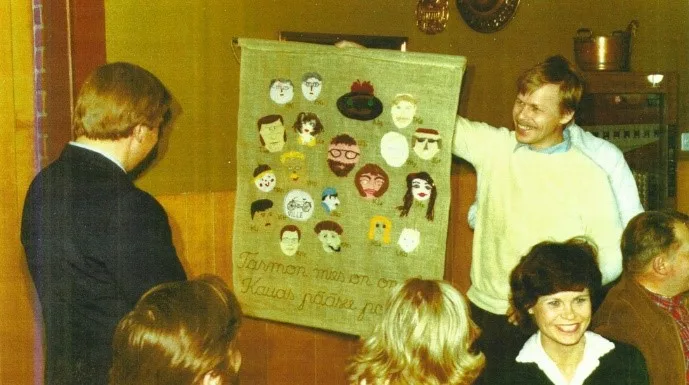
In its early years, Comatec was marked by constant work and rapid expansion. In the late 1980s, Finland’s economy was booming, and the technology and machinery industries offered plenty of projects. Comatec quickly gained significant clients: Tampella, Posti, Outokumpu, Valmet and Kasten were among its first long‑term partners.
The next challenge came with the recession of the early 1990s, when Finland’s economy collapsed. Comatec avoided redundancies, although cash flow had to be patched up through creative means such as offsetting invoices with equipment. Aulis later recalled the period as difficult but instructive, shaping his view of indebtedness and risk management.
In the late 1990s, Comatec invested in digitalisation and 3D design. Cooperation with the University of Tampere led to research predicting a rapid shift to 3D technology. Aulis decided to invest in new software and in strengthening staff competencies, even though the results would take years to materialise. The decision turned out to be the right one, keeping the company competitive in rapidly changing markets.
The 2000s marked Comatec’s strongest growth period. In ten years, the workforce increased from 30 to 300, and Comatec moved from the SME category into that of major companies. Acquisitions became part of the growth strategy and the foundation of the group’s diversified structure. Aulis nevertheless set a clear principle for growth: “Growth must be managed.”
Towards Internationalisation Despite Crises
The 2008 financial crisis hit hard. Several major customers suspended their projects almost overnight, and temporary layoffs became unavoidable. That same summer, Comatec had completed the largest acquisition in its history, complicating the situation further. Aulis later admitted that it was one of the most difficult moments of his career.
Retreating to the peace of the countryside in Heinävesi helped to regain clarity. Aulis decided that the company’s growth would not stall permanently; the direction would be towards a more international and more deeply skilled organisation. In 2011, Comatec again reached the record turnover of 2008.
During the 2010s, the organisational structure was reformed around expertise. The focus shifted from allocating resources to building strong specialist areas capable of serving both domestic and international clients. Acquisitions also continued.
By 2021, Comatec had completed around 40 acquisitions, roughly half being business transfers and half share acquisitions. The “tree” called Comatec had grown many branches. The parent company’s name has remained unchanged since the late 1980s, although the company has since evolved into a group with multiple subsidiaries: Comatec Group.
Reforms in a Changing Operating Environment
Between 2021 and 2026, Comatec continued its internationalisation and made structural changes aimed at clarifying the corporate structure and strengthening cooperation.
“In our 35th anniversary year in 2021, we reorganised the structure and established Comatec Industrial and Marine Oy and Comatec Mobility Oy. The change was needed to respond more clearly to the needs of different sectors,” says Aulis.
According to Aulis, the change was also strategic: the aim was to ensure focus, scalability and competitiveness in an operating environment changing faster than ever. The pandemic years and global upheaval challenged Comatec as well, and although adapting to the ‘new normal’ became essential, the direction remained clear. The group acquired, among others, Fimecon Oy’s design operations in Kuopio and Varkaus. New offices were also opened, including in Kotka and Vaasa.
Growth has not been limited to Finland.
“In autumn 2022, we took a significant step in our internationalisation by launching operations in Sweden under Comatec Sweden Ab in Gothenburg. Sweden was a natural expansion area due to our existing client base, the electrification of transport and machinery, and the broad technological customer landscape. Local presence is a key part of our growth strategy.”
The ability and capacity to serve international clients also grew in the marine industry when Deemec Oy, acquired in 2019, and its Romanian subsidiary were integrated into Comatec Industrial and Marine Oy in 2022.
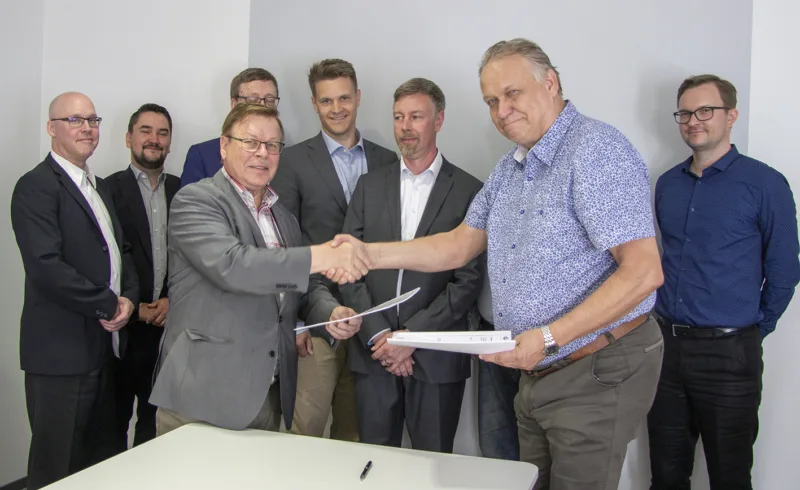
At this point, the group had 11 companies operating in five countries.
Of these, four companies worked in the plant and process industry, and they were therefore merged with a single management and organisation to form a stronger whole. This major structural change took place at the beginning of 2025 when Oucons Oy, Rantotek Oy, Comatec Automation Oy and Comatec Project Services Oy were merged into Comatec Process and Automation Oy. Comatec Mobility Oy and Comatec Industrial and Marine Oy continue within their respective clearly defined sectors. All group companies continue operate under the unified Comatec brand.
People as the Most Important Asset of an Expert Organisation
At Comatec, expertise is recognised as a key strategic factor. Competence grows not only through acquisitions but also by actively recruiting skilled professionals and by developing existing personnel through our own Comatec Academy.
“Our group is full of experts with excellent skills. However, we operate in many rapidly evolving sectors. We continuously strengthen our expertise to ensure we can serve new markets and support our existing customers with their growing and changing needs.”
Aulis admits that when he sat in his own one room office on his first working day, he could not have imagined his company’s future stretching this far.
According to Aulis, the most challenging aspect of entrepreneurship has been managing change, which is inevitably part of entrepreneurial work. One thing he has noticed is that attitude plays a major role. He acknowledges that he is more of an optimist than a pessimist.
“I have observed that those who see monsters everywhere rarely manage to create or build anything new.”
A Rolling Stone Gathers No Moss
Although the stories of the past are plentiful, Aulis is looking towards the future, and the direction is clear.
“Growth and internationalisation remain at the core of our strategy. We continue to develop our service capabilities and knowledge base both in Finland and abroad, and we will also keep investing in research‑based knowledge.”
One sign of this commitment to developing competence is Comatec’s funding of a new professorship of practice launched in 2025 at Tampere University to support the sales of investment products and technology services – something Aulis is visibly enthusiastic about.
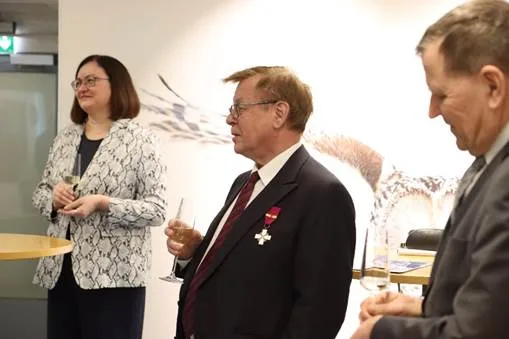
“In a rapidly changing world, continuous development is essential for us. Comatecians have both the desire and the ability to grow and learn. Ongoing development of expertise strengthens our competitiveness and ensures our capability for large international projects.”
“Im proud that the work of our designers still visible in Finland and around the world: in the massive postal sorting centre in Helsinki, in conveyor systems across Central Europe, in power plants in Asia.”
Aulis’s frequently used motto, “a rolling stone gathers no moss”, aptly captures the spirit of Comatec: constant movement and development. With Asikainen’s footsteps as our guide, we continue forward.